The past
History of the manor house
The manor house in Hradná is inseparably linked with the history of the region, with the noble Akay and Madocsányi families – and even with the writer Mór Jókai.
The Akay family
In the mid-16th century Sebestyén Syrmiensis (Szulyovszky) acquired Hradná and Súľov together with Súľov Castle. After his death Hradná passed to his daughter Katalin, who married Pál Akay. In this way most of the village came into the hands of the Akay family – in Hungarian sources akai és hradnai Akay, the Akays of Aka and Hradná. An abandoned manor house is already recorded here in 1591. The Akays built the present manor house around 1600, probably on its foundations, and it then remained in the family for more than two hundred years. The family held offices in Trenčín County; in 1640 György Akay, together with Gáspár Ordódy, received a new royal grant of the Szőlő estate in the same county.
The Renaissance building was modelled, on a smaller scale, on the Thurzó manor house in nearby Bytča and served as a country residence of the estate. It bears witness to the lively building activity in the Bytča region at the end of the 16th and beginning of the 17th century.
The kuruc captain István Akay, son of Pál II and Mária Kubinyi, was born in the manor house around 1680; his brother György, captain of Árva from 1703, also fought with the kuruc insurgents. The family also produced two Jesuits, the brothers János († 1754), who taught in Trnava and Košice, and Péter, known in the order as Kristóf († 1766), author of the extensive Cosmographia seu philosophica mundi descriptio (1737) on the astronomy and physics of his day, which was reprinted three times. According to Iván Nagy, Kristóf was born in 1704 in Trenčín; according to Ákos Karczag, in 1706 in the manor house at Hradná. A deed of inheritance from 1781 describes the 18th-century manor in detail: the heirs divided its rooms, cellars and farm buildings between them.
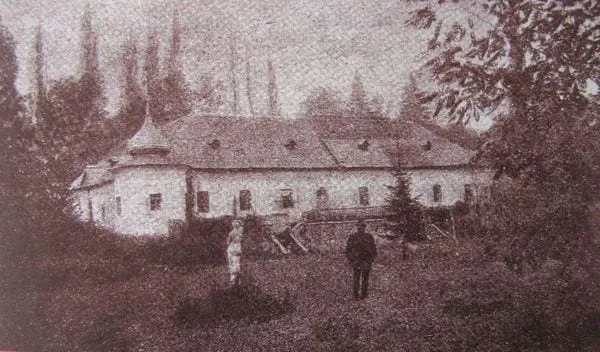
Family tree
The Lords of Hradná
The direct line of the family from Pál I to Mária Madocsányi, after the family tree compiled by Iván Nagy.
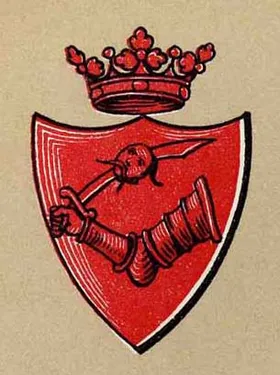
The family coat of arms
On a red shield an armoured arm holds a sabre with a Turk’s head impaled on it – a common motif in Hungarian noble heraldry recalling the wars against the Ottomans. Above the shield is a crown.
The arms of the Akay de eadem et Hradna family survive, for example, on the 1820 seal of František (Ferenc) Akay, a juror of Trenčín County, published in Magyarország címeres könyve. The family tree was compiled by the genealogist Iván Nagy in Magyarország családai czímerekkel és nemzékrendi táblákkal.
Iván Nagy describes an older form of the arms from the 1703 seal of the kuruc captain István Akay: a rampant lion facing left, beside it an arm brandishing a sword, and a star on the right.
The 19th-century heyday
The last male descendant of the Trenčín branch of the family was József Akay. Under him the estate fell into decline: bankruptcy proceedings were opened against him in 1849 and were not concluded until 1887, and in the meantime the manor house was let. After his death the indebted property passed to his sisters Mária and Karolina. In 1867, at Mária’s request, her husband Pál Madocsányi bought the manor out so that it would not pass into the hands of strangers.
The manor house flourished most after 1875, when the widowed Mária Madocsányi settled permanently in Hradná. She surrounded it with a park planted with exotic trees. In front of the house was a pond with fish, water plants and a fountain, fed by water flowing from the mouths of two stone lions. Carriages entered the courtyard through the north gate; a dovecote stood in the middle, and there was also a greenhouse.
Great banquets were held here, attended mostly by nobles from Budapest, and musicians from Vienna played in the garden full of rare plants. Beer was even brewed in the manor – which is why the street on its north side is still called Pivovarská (Brewery Street).
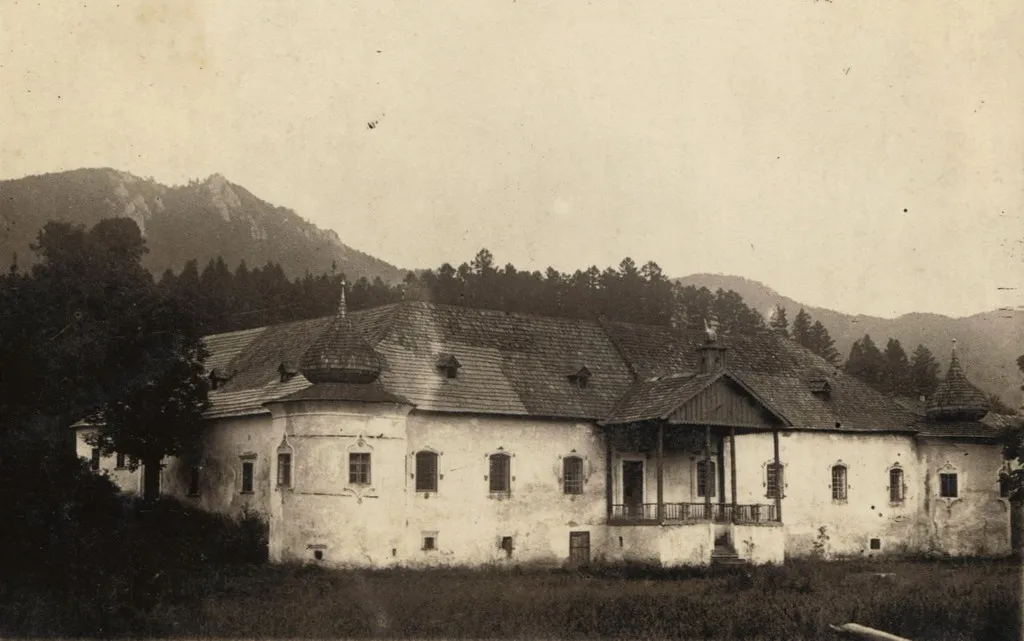
The revolutionary year 1848
Pál Madocsányi, chief notary of Liptó County, came from a prominent gentry family from Madočany in the Liptov region. He belonged to the Hungarian nobility, and in 1848/49 the Hungarian government appointed him government commissioner for the northern counties and the mining towns. He also organised the fight against the Slovak volunteer expeditions.
During this revolutionary time Mária Madocsányi caught the attention of the newspapers of the day. They described her courage when the volunteer troops of Jozef Miloslav Hurban, a leader of the Slovak uprising, arrived in Madočany: instead of leaving the manor, she spoke with their commander and gave the soldiers food – and with this gesture saved her residence from being looted.
After the defeat of the revolution he was sentenced to death. By way of pardon the sentence was commuted to six years of fortress imprisonment, five of which he served in Josefstadt. After his release in 1855 he gradually returned to public life: in 1861 he became lord-lieutenant of Trenčín County and in 1865 a member of the Hungarian Diet. He retired in 1872 and died in 1875.
Mór Jókai in Hradná
The beauty of the manor and the nearby Súľov Rocks drew many distinguished guests to Hradná. The writer Mór Jókai, author of numerous historical novels set in Hungarian history, first travelled through the Váh valley in August 1879. From 24 August to 6 September 1880 he returned to the region, and in the last days of August he stayed in Hradná – exactly how long is not known. According to the village memorial book, he was lodged in the round corner tower on the right-hand side of the north-west façade. Together with Pál Andaházy, a relative of Mária Madocsányi, he visited the sights of the area: the Bytča manor and the castles of Strečno, Hričov and Považská Bystrica. The stories he heard from his companions and hosts on these journeys later found their way into his novels.
On 30 August 1880 he made a pencil drawing of the manor house in his sketchbook, adding the inscriptions “1436” and “Hradna”, and noted it as “an extensive single-storey manor house in a park, with a round tower at two of its corners”.
Drawing was more than a pastime for Jókai. As a young man he trained as a painter: from 1837 to 1840 he attended the Royal Drawing School in Komárom under Gábor Orbán, and while still at school he drew portraits of his relatives and of well-known figures of the town. As a law student in Kecskemét (1842–1844) he taught his fellow students to draw and paint. He produced portraits in oils, watercolour and pencil, landscapes, town scenes, caricatures, illustrations and self-portraits – but in the end he chose literature.
He later wrote the manor house into his novel Szeretve mind a vérpadig (Loved unto the Scaffold, 1882) about the kuruc commander László Ocskay. After describing the Súľov Rocks, he writes:
“From here opens the beautiful valley of Hradná with its ancient manor house, built as long ago as the time of King Sigismund…”
„Innen nyílik azután a gyönyörű hradnai völgy, ősi kastélyával, ami még Zsigmond király idejében épült…”
In the same novel, Ocskay’s wife plans to break her journey from Lietava and spend the night “in the manor house at Hradná”. The Akays appear in it too: Ocskay boasts of having confirmed them in their loyalty to Prince Rákóczi at Hričov Castle. The year 1436 and the reference to King Sigismund reflect what was then believed about the building’s age; the manor house in its present form dates from around 1600, while an older manor house in Hradná is recorded in 1591.
Hradná also appears in the later novel A lélekidomár (The Tamer of Souls, 1889), in the chapter Az elrabolt kincs (The Stolen Treasure). The hero, Lándory, searches for a stolen chest hidden in the ruins of Lietava Castle and spends the night at the Hradná manor house. He arrives on the pretext of painting the ruins with a companion posing as an artist – much as Jókai himself sketched the manor house. Its mistress – the widow of a government commissioner from the revolution of 1848/49, living in the ancient manor “completely withdrawn from the world” – was probably modelled on Mária Madocsányi. Jókai writes that the people of the area know of her only through her charity, and that “her whole life is active goodness and patient suffering”.
Hradná left its deepest mark, however, on Jókai’s last novel, Börtön virága (The Prison Flower, 1904). Its main characters, Dezső Markóczy and his wife Viola, are modelled on the former lord of the manor, Lord-Lieutenant Pál Madocsányi, and his wife Mária, née Akay. In 1848 Markóczy is a government commissioner and major of the National Guard who fights the Slovak insurgents; after the defeat of the revolution he is sentenced to death, the sentence is commuted to imprisonment, and he is finally released under an amnesty. Jókai puts the wife’s hardships and courage at the centre of the book – the material most likely came from Mária Madocsányi herself, who told him her story during his stay in Hradná.
Jókai also described the astonishing strangeness of the Súľov Rocks in his travel sketch A Vág völgye (The Váh Valley), part of the section A Kárpátok között (Among the Carpathians) of his travel writings Útleírások.
The 20th century and decline
Mária Madocsányi died in 1894 at the age of 76. At her wish she was buried in a crypt behind the manor house, surrounded by spruce trees. Because the crypt was in poor condition, her remains were moved to the village cemetery in May 1941.
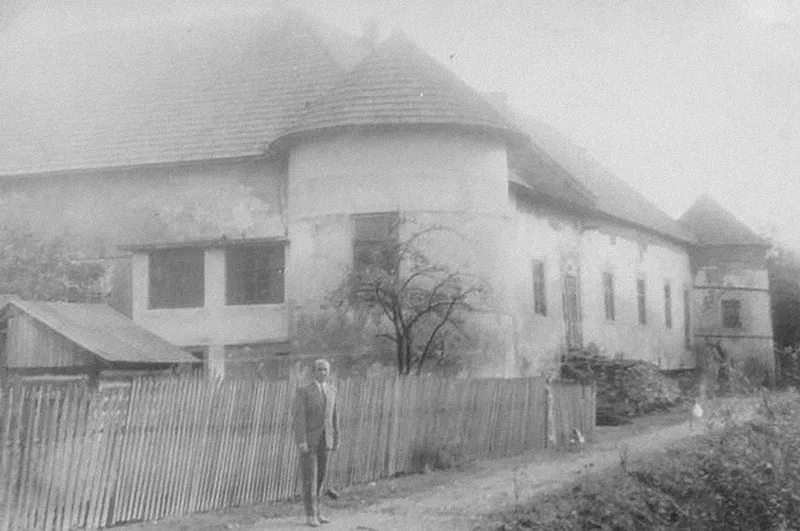
The manor house was inherited by her relative Pál Andaházy (1835–1914), for many years the estate manager. For unknown reasons he had the ornamental garden removed, and the manor became part of the estate to which the neighbouring manor house in Súľov (today the Mičura manor) also belonged. Around 1913 it was bought by the Viennese timber merchant Karl Alexander, then by Dezső Szulyovszky, who sold it to the Tatra Bank in 1920. From 1928 to 1930 the house was used as a school, and in 1931 the pond was filled in. In 1933 the estate was bought by Vincent Mičura, who had the century-old lime trees around the manor felled and rebuilt the house unprofessionally, demolishing some of its walls.
In 1937 the people of Hradná bought the manor house in several parts and divided it among themselves in 1944. Some of the new owners lived in it; in the second half of the 20th century it housed a shop, and one of its large halls was used for dances. Most of the building, however, stood unused, and the owners neglected it entirely. In 1963 the manor house was listed as a National Cultural Monument. Already at an inspection in 1964 its condition was described as very poor – and the devastation continued. In February 2006 the roof truss of the north-east wing collapsed under the weight of snow.
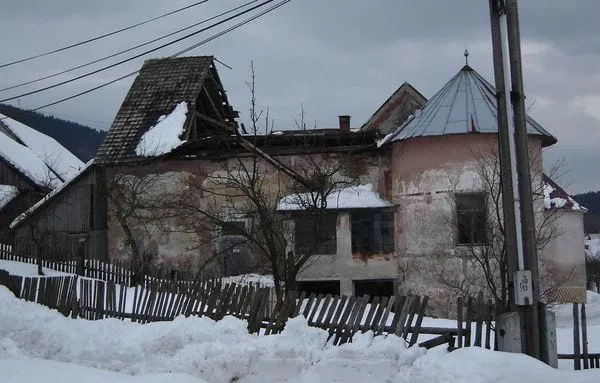
What the manor house looks like today →
Information on the owners of the manor house, the Akay and Madocsányi families and Mór Jókai’s visit is based on Ákos Karczag’s historical study A szulyóváraljai kastélyok évszázadai.
Memories
Do you have old photographs or memories?
Family photographs, postcards, documents and memories of local people can fill in the history of the manor house. Every detail helps the restoration – including the reconstruction of the original roofs and façade.
Contact